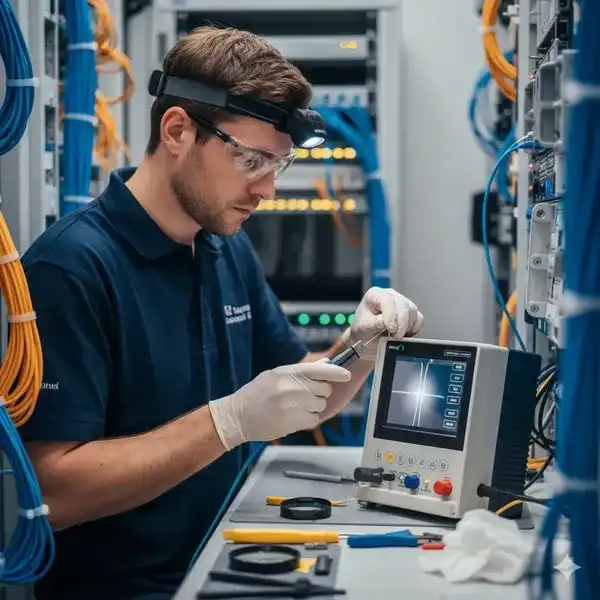
Ethernet Cable Testing & Certification: An In-depth Look at Fluke DTX/DSX Methodologies for UK Installations
As Gary Pearce, a UK-certified installer with extensive experience in data cabling infrastructure, I frequently encounter scenarios where the foundational integrity of a network is either overlooked or misunderstood. In our interconnected world, where data is king and downtime is catastrophic, the physical layer – the cabling itself – remains the unsung hero. Its proper installation and, crucially, its rigorous certification, are paramount for reliable, high-performance network operations.
For UK installations, adherence to both international and European standards is not merely good practice; it’s a professional obligation and often a contractual requirement. This post will delve into the indispensable methodologies offered by Fluke Networks’ industry-leading DTX and DSX CableAnalyzer™ series, examining how these tools provide the precision and diagnostic capability essential for certifying modern Ethernet cabling to the highest standards.
The Imperative of Certified Ethernet Infrastructure in the UK
Modern networks, from enterprise data centres to small office setups, demand unwavering reliability and ever-increasing bandwidth. Technologies like 10 Gigabit Ethernet (10GbE), 25 Gigabit Ethernet (25GbE), and even 40 Gigabit Ethernet (40GbE) over twisted-pair copper, along with the pervasive adoption of Power over Ethernet (PoE) for devices ranging from IP cameras to access points, place immense pressure on the underlying cabling.
Without proper testing and certification, installers and end-users alike are merely speculating about performance. A cable run might appear to work, passing basic connectivity tests, but under load or specific environmental conditions, it could introduce subtle errors, latency, or even catastrophic failures. These issues are notoriously difficult and expensive to diagnose post-installation.
Certification provides:
- Proof of Performance: Verifiable data confirming the cable meets specified performance criteria (e.g., Cat6A for 10GbE).
- Warranty Validation: Most reputable cable manufacturers require certified test results to validate their system warranties.
- Troubleshooting Efficiency: Baseline performance data makes future fault finding quicker and more targeted.
- Future-Proofing: Ensures the infrastructure can support current and anticipated future network demands.
- Professional Integrity: Demonstrates compliance with industry standards and best practices, enhancing an installer’s reputation.
For UK installers, compliance with standards such as ISO/IEC 11801, EN 50173, and TIA-568.x is fundamental. These standards dictate the performance parameters that must be met for various cable categories, and only a professional cable certification tester can accurately measure these parameters.
The Evolution of Network Certification: From Fluke DTX to DSX CableAnalyzer™ Series
Fluke Networks has long been the gold standard for cable certification. Their commitment to accuracy, speed, and comprehensive diagnostic capabilities has made their testers ubiquitous in the data cabling industry worldwide, including here in the UK.
The Legacy of the DTX CableAnalyzer
The Fluke DTX CableAnalyzer series, including models like the DTX-1800, revolutionised cable testing when it was introduced. It offered unprecedented speed and accuracy for certifying copper cabling up to Category 6A (10 Gigabit Ethernet) and fibre optic links. Key features that made the DTX a stalwart included:
- Fast Test Times: Significantly reducing the time required to certify a link, often completing a Cat 6 autotest in under 9 seconds.
- Comprehensive Diagnostics: Utilising HDTDX (High Definition Time Domain Crosstalk) and HDTDR (High Definition Time Domain Reflectometry) to pinpoint the exact location of faults such as impedance mismatches, opens, shorts, and crosstalk sources.
- Reporting: Seamless integration with LinkWare™ PC software for professional report generation.
- Modular Design: Allowing for copper, fibre, and industrial Ethernet testing with interchangeable modules.
While the DTX series remains a highly capable instrument and is still widely used for Cat 5e and Cat 6 installations, the ever-increasing demands of network performance and the introduction of new cabling categories necessitated the next generation.
Introducing the DSX CableAnalyzer™ Series (DSX-5000/DSX-8000): The Current Benchmark
The Fluke Networks DSX CableAnalyzer™ series, part of the modular Versiv™ family, represents the pinnacle of copper cable certification technology. The DSX-5000 certifies cabling up to Category 6A/Class EA, while the DSX-8000 extends this capability to Category 8/Class I & II, specifically designed for 25GbE and 40GbE applications.
Key advancements and features of the DSX series include:
- Versiv™ Platform Integration: A unified, modular platform that supports copper, fibre optic loss and OTDR, and Wi-Fi analysis. This means a single user interface and consolidated reporting, simplifying training and asset management.
- Unparalleled Speed: The DSX-5000 can perform a Cat 6A test and save the results in just 8 seconds. The DSX-8000 matches this speed for Cat 6A and performs a Cat 8 test in approximately 16 seconds.
- Extended Frequency Range: The DSX-8000 tests up to 2 GHz, far exceeding the 500 MHz required for Cat 6A, making it future-ready for Cat 8.
- ProResistant™ Adapters: These ruggedised adapters are designed for extreme durability and precision, reducing the need for frequent replacement, a significant operational advantage on busy UK installation sites.
- Enhanced Diagnostics (HDTDX/HDTDR): Even more precise fault location capabilities, allowing technicians to identify exactly where a problem lies (e.g., a specific connector, a crushed cable section) with greater accuracy. This is critical for rapid troubleshooting and rework minimisation.
- LinkWare™ Live: Cloud-based service for managing test results, enabling project managers to remotely monitor job progress, merge results from multiple testers, and generate reports from anywhere. This is invaluable for multi-site UK projects or remote teams.
- TCL/ELTCTL Testing: The DSX series can also measure Transverse Conversion Loss (TCL) and Equal-Level Transverse Conversion Transfer Loss (ELTCTL), which are crucial parameters for assessing a cable’s immunity to common-mode noise, especially important in industrial environments and for ensuring robust PoE performance.
For any UK installer serious about delivering future-proof, high-performance network infrastructure, the Fluke DSX CableAnalyzer series is the unequivocal tool of choice.
Understanding UK and International Cabling Standards
Cabling standards define the electrical characteristics and physical requirements for structured cabling systems, ensuring interoperability and guaranteed performance. In the UK, we primarily adhere to European and International standards, though TIA standards are often referenced due to global equipment manufacturing.
Core Standards for Copper Cabling:
- ISO/IEC 11801 (Information Technology - Generic Cabling for Customer Premises): This is the international umbrella standard. It defines generic cabling structures and specifies performance requirements for various cabling classes (e.g., Class D for Cat 5e, Class E for Cat 6, Class EA for Cat 6A, Class F for Cat 7, Class FA for Cat 7A, Class I for Cat 8.1, Class II for Cat 8.2). It is the most authoritative standard for generic structured cabling globally.
- EN 50173 Series (Information Technology - Generic Cabling Systems): The European equivalent to ISO/IEC 11801. It often mirrors the ISO standards but provides a specific European context and sometimes includes additional regional requirements. For UK installations, EN 50173 is directly applicable.
- TIA-568.x (Commercial Building Telecommunications Cabling Standard): Developed by the Telecommunications Industry Association (TIA) in North America, this series (e.g., TIA-568.C.2 for balanced twisted-pair cabling) is widely referenced due to its early adoption and global influence. It defines categories (Cat 5e, Cat 6, Cat 6A, Cat 8) that are broadly harmonised with ISO/IEC classes.
- IEEE 802.3 (Ethernet Standards): This family of standards defines the physical layer and media access control for wired Ethernet networks. While not directly a cabling standard, IEEE 802.3 specifications (e.g., 802.3ab for 1000BASE-T, 802.3an for 10GBASE-T, 802.3bq for 25G/40GBASE-T) define the electrical performance requirements that the underlying cabling must support to allow these Ethernet protocols to function correctly.
Performance Categories and Test Limits:
Cabling categories and classes specify the maximum frequency bandwidth and associated data rates they can support:
| Category/Class | Max Frequency (MHz) | Typical Data Rate |
|---|---|---|
| Cat 5e / Class D | 100 | 1 Gbps (1000BASE-T) |
| Cat 6 / Class E | 250 | 1 Gbps (1000BASE-T) |
| Cat 6A / Class EA | 500 | 10 Gbps (10GBASE-T) |
| Cat 7 / Class F | 600 | 10 Gbps (10GBASE-T) |
| Cat 7A / Class FA | 1000 | 10 Gbps (10GBASE-T) |
| Cat 8 / Class I/II | 2000 | 25/40 Gbps (25G/40GBASE-T) |
Crucially, certification involves testing both the Permanent Link and the Channel Link.
- Permanent Link: Consists of the horizontal cable (bulk cable) and the connectors at each end (usually the wall outlet/patch panel and the telecommunications outlet). This is typically what installers certify.
- Channel Link: Includes the Permanent Link plus any patch cords connecting active equipment (e.g., patch panel to switch, wall outlet to PC). This is a longer, more comprehensive test, often performed by end-users or for specific troubleshooting scenarios. Fluke testers can certify both, but the Permanent Link is the cornerstone for installer certification.
The Critical Parameters of Copper Cable Certification
A certification tester like the Fluke DSX CableAnalyzer doesn’t just check for continuity; it performs a suite of sophisticated electrical measurements to ensure the cable link meets the stringent performance requirements defined by the standards.
Core Electrical Tests:
- Wire Map: This fundamental test verifies correct pin-to-pin termination (e.g., T568B to T568B), checks for opens, shorts, crossed pairs, reversed pairs, and split pairs. A split pair, while electrically connected, can severely degrade performance, especially crosstalk.
- Length: The physical length of each wire pair is measured using Time Domain Reflectometry (TDR). This ensures the cable segments do not exceed the maximum allowed lengths specified by standards (e.g., 90m for horizontal cable in a permanent link).
- Attenuation (Insertion Loss): This measures the loss of signal strength as it travels along the cable. It’s frequency-dependent – higher frequencies experience greater attenuation. Excessive attenuation can lead to received signals being too weak for reliable decoding. The DSX measures this across the entire frequency range.
- Return Loss (RL): RL quantifies the amount of signal reflected back towards the source due to impedance mismatches along the cable link. These mismatches can occur at connectors, kinks, or poor terminations. High RL indicates poor impedance control, leading to signal degradation.
- Near-End Crosstalk (NEXT): NEXT measures the unwanted coupling of signals from an adjacent pair into the pair being tested, measured at the same end as the transmit signal. High NEXT indicates poor pair twisting or termination practices.
- Power Sum NEXT (PS-NEXT): Modern networks often use all four pairs simultaneously. PS-NEXT measures the cumulative NEXT effect from all adjacent pairs interfering with the receiving pair, providing a more realistic assessment of crosstalk.
- Far-End Crosstalk (FEXT) / Equal-Level Far-End Crosstalk (ELFEXT) / ACR-F: FEXT measures crosstalk at the far end of the cable. ELFEXT (or ACR-F, Attenuation-to-Crosstalk Ratio, Far-End) compensates FEXT for the attenuation of the disturbing and disturbed pairs, providing a clearer picture of crosstalk independent of length.
- Power Sum ACR-F (PS-ACR-F): Similar to PS-NEXT, this measures the cumulative effect of FEXT from all adjacent pairs on the receiving pair, compensated for attenuation.
- Attenuation-to-Crosstalk Ratio, Near-End (ACR-N) / ACR-P (Power Sum ACR-N): ACR-N is a critical metric calculated as the difference between attenuation and NEXT. A positive ACR-N indicates that the received signal is stronger than the crosstalk noise. PS-ACR-N applies this concept to power sum values. These metrics are crucial for data integrity.
- Propagation Delay: The time it takes for a signal to travel from one end of the cable to the other.
- Delay Skew: This measures the difference in propagation delay between the fastest and slowest wire pairs within a single cable. Large delay skew can lead to timing errors in high-speed data transmission, especially problematic for 10GbE and higher.
- DC Loop Resistance: Measures the total DC resistance of a twisted pair. This parameter is increasingly vital for Power over Ethernet (PoE) applications, as excessive resistance leads to voltage drop and power loss, potentially preventing powered devices from operating correctly. The DSX series accurately measures this per pair.
- Transverse Conversion Loss (TCL) / Transverse Conversion Transfer Loss (TCTL): These measure the cable’s ability to reject common-mode noise. A high TCL/TCTL value signifies excellent noise immunity, crucial in environments with significant electromagnetic interference (EMI).
The DSX CableAnalyzer will test all these parameters against the selected standard’s limits across the entire specified frequency range, providing detailed graphical representations and clear pass/fail indications for each.
Fluke DSX Methodologies: A Step-by-Step Approach for UK Installers
Implementing Fluke DSX methodologies ensures consistent, accurate, and verifiable results for UK installations.
Pre-Certification Checklist:
Before commencing testing, meticulous preparation is key:
- Cable Identification: Ensure all cable runs are clearly labelled and match your as-built documentation.
- Correct Cable Type Selection: On the DSX tester, accurately select the cable type (e.g., Cat6A U/UTP, Cat7A S/FTP) and manufacturer if possible, to apply the correct nominal velocity of propagation (NVP) for accurate length measurements.
- Test Limit Selection: Critically, choose the correct test limit (e.g., “ISO Class EA Permanent Link” for Cat6A, or “TIA Cat 6A Permanent Link”). This dictates the pass/fail criteria.
- Calibrated Equipment: Verify the DSX CableAnalyzer is within its calibration period. Fluke recommends annual calibration.
- Clean Connectors/Adapters: Use Fluke’s recommended cleaning kits to ensure test lead and adapter ports are free from dust and contaminants. Dirty connectors are a primary cause of inaccurate results and ‘false fails’.
- Fully Charged Batteries: Ensure both the Main and Remote units are fully charged to avoid interruptions.
- Environmental Considerations: Be aware of extreme temperatures or humidity, which can affect cable performance and tester accuracy.
Configuring the DSX CableAnalyzer:
The intuitive Versiv™ interface makes setup straightforward:
- Power On: Turn on both the Main and Remote units.
- Select Test: From the home screen, tap “TOOLS” then “Project” to create a new project or select an existing one. Then tap “Test Setup”.
- Choose Test Limit: Select the appropriate cabling standard (e.g., ISO, TIA) and category/class (e.g., Class EA, Cat 6A), and the link type (Permanent Link or Channel Link). Confirm PoE standards if relevant (e.g., IEEE 802.3bt Type 3/4 for high-power PoE).
- Select Cable Type: Specify the cable manufacturer, type, and gauge if known, for improved accuracy.
- Save Test Settings: Save these settings as part of your project.
- Connect Adapters: Attach the appropriate Permanent Link Adapters (or Channel Adapters) to both the Main and Remote units.
- Attach to Cable: Connect the Main unit’s adapter to the patch panel/outlet at one end and the Remote unit’s adapter to the corresponding outlet/patch panel at the other end of the cable run. Ensure secure connections.
Executing an Autotest:
Once connected and configured, initiate the test:
- Start Autotest: On the Main unit, tap the “Autotest” button.
- Monitoring Progress: The tester will rapidly perform all required measurements. You’ll see a progress bar and, typically, a wire map diagram updating in real-time.
- Results Display: Upon completion, a summary screen will appear, clearly indicating “PASS” or “FAIL” for the link.
Interpreting Results and Troubleshooting:
- PASS/FAIL: A green “PASS” indicates the link meets all selected test limit requirements. A red “FAIL” means one or more parameters are out of specification.
- Graphical Analysis: For a “FAIL,” the DSX’s diagnostic capabilities are invaluable. Tap on the failed parameter to view detailed graphs (e.g., NEXT, Return Loss, Attenuation vs. Frequency).
- HDTDX/HDTDR: The DSX will often automatically pinpoint the fault location on a graphical representation of the cable length.
- HDTDX (High Definition Time Domain Crosstalk) shows where crosstalk issues are located, helping identify problematic connectors or cable damage.
- HDTDR (High Definition Time Domain Reflectometry) indicates the location of impedance mismatches, opens, or shorts.
- Common Faults and Solutions:
- Wire Map Errors: Re-terminate connectors, check for mis-wires, crossed pairs, or split pairs.
- High Attenuation: Check cable length (over-length?), cable quality, connector termination, or damaged cable sections (e.g., crushed cable).
- High NEXT/PS-NEXT: Re-terminate connectors with proper untwist at the termination point, ensure correct component matching (e.g., Cat6A components for Cat6A cable), or check for tight cable ties distorting cable geometry.
- High Return Loss: Inspect connectors for proper termination, ensure consistent cable bend radius, check for poor quality patch cords (if testing channel).
- DC Resistance Fail: Critical for PoE. Check for poor conductor connections, excessively long cables, or undersized conductors (not meeting minimum gauge).
By leveraging the DSX’s diagnostic power, a UK installer can quickly identify the root cause of a failure, rectify it, and re-test, minimising costly rework and maximising efficiency.
Reporting, Documentation, and UK Compliance
The certification process culminates in comprehensive documentation, which is vital for project handover, warranty claims, and future network management.
- LinkWare™ PC Software: This free software from Fluke Networks allows you to download all test results from the DSX CableAnalyzer to a PC. You can then organise, analyse, and generate professional reports in various formats (PDF, HTML). These reports typically include:
- Summary of all tested links (Pass/Fail).
- Detailed results for each link, including graphical plots for all parameters.
- Test setup details (standard, cable type, tester serial numbers).
- Installer and customer information.
- LinkWare™ Live: For large projects or distributed teams, LinkWare Live offers a cloud-based solution. Test results can be uploaded directly from the DSX tester via Wi-Fi to a secure cloud account. Project managers in the office can then view results in real-time, generate reports, and merge data from multiple testers. This streamlines project management and ensures all documentation is centrally accessible, crucial for complex UK infrastructure projects.
- Meeting Client Expectations and Regulatory Requirements: Providing certified test results is often a contractual obligation. It demonstrates that the installation complies with relevant standards (e.g., EN 50173, ISO/IEC 11801) and any specific project specifications. This evidence is invaluable for ensuring adherence to industry best practices and, indirectly, to relevant building regulations or health and safety standards where network reliability is a factor.
- Proof of Warranty Compliance: Most structured cabling system manufacturers offer extended warranties (e.g., 20 or 25 years) on the condition that the system is installed and certified by an approved installer using calibrated equipment, with all test results documented. Fluke certification is universally accepted for this purpose.
The Financial and Operational Advantages of Certification
Investing in high-quality certification equipment like the Fluke DSX CableAnalyzer, and rigorously applying its methodologies, yields significant financial and operational benefits:
- Reduced Downtime & Increased Reliability: A certified network is a reliable network. This translates directly to less downtime for users and business-critical applications, preventing lost productivity and revenue.
- Future-Proofing Infrastructure: By certifying to the highest applicable standards (e.g., Cat6A for 10GbE), you ensure the physical infrastructure can support future technology upgrades without needing costly re-cabling.
- Meeting PoE Requirements: Accurate DC loop resistance and balance measurements are crucial for reliable PoE delivery. Certification ensures the cabling can safely and efficiently power connected devices, preventing issues like insufficient power or device malfunction.
- Enhancing Installer Reputation: Consistently delivering certified, high-performance networks builds trust and reputation within the competitive UK market, leading to repeat business and referrals.
- Avoiding Costly Reworks: Identifying and rectifying cabling faults during installation is significantly cheaper and less disruptive than troubleshooting them once the network is live and operational. The diagnostic capabilities of the DSX series are invaluable here.
Conclusion: Ensuring Robust UK Network Performance
In the demanding landscape of modern UK network installations, Ethernet cable testing and certification are not optional extras; they are fundamental requirements for delivering reliable, high-performance, and future-proof infrastructure. The Fluke Networks DTX and, more recently, the DSX CableAnalyzer series provide the unparalleled accuracy, speed, and diagnostic depth necessary to meet and exceed these requirements.
As Gary Pearce, I cannot stress enough the importance of adopting these professional methodologies. It ensures compliance with critical international and European standards, validates manufacturer warranties, and ultimately underpins the integrity and efficiency of the entire network. For any UK installer striving for excellence and long-term client satisfaction, embracing Fluke certification is the clear path forward.
Frequently Asked Questions (FAQ)
Q1: Why can’t I just use a simple cable continuity tester?
A simple continuity tester only checks for basic wiring faults like opens, shorts, and mis-wires. It provides no information about the cable’s performance characteristics such as attenuation, crosstalk, return loss, or delay skew. These are critical parameters that determine whether a cable can reliably support high-speed data (e.g., 1GbE, 10GbE, 40GbE) and PoE. Using only a continuity tester is akin to checking if a car’s engine turns on, but not whether it can reach its top speed or pass an MOT emissions test. For certification, a full-featured cable certifier like the Fluke DSX is essential to ensure compliance with industry standards and guaranteed performance.
Q2: What’s the difference between a Permanent Link and a Channel Link test?
The Permanent Link test certifies the fixed infrastructure of the cabling system. It includes the horizontal cable run from the patch panel in the telecommunications room to the work area outlet, along with the connectors at both ends. This is typically the test performed and certified by installers. It uses dedicated, high-quality permanent link adapters on the tester that simulate equipment connections without including patch cords.
The Channel Link test includes everything in the Permanent Link, plus any patch cords used to connect active network equipment (e.g., patch panel to switch, work area outlet to PC). It’s a more comprehensive test of the entire end-to-end path that data will travel, including the performance of the patch cords. While useful for troubleshooting a live network, installers primarily certify the Permanent Link as patch cords are often sourced separately and can be changed by the end-user.
Q3: How often should my Fluke tester be calibrated?
Fluke Networks recommends that their CableAnalyzer series testers (including DTX and DSX) be calibrated annually. Regular calibration ensures the accuracy of the measurements and guarantees that the tester continues to meet the stringent requirements of the industry standards. Using an uncalibrated tester can lead to inaccurate results, potentially causing “false passes” on faulty cables or “false fails” on good cables, both of which can lead to significant cost and time implications. Fluke provides a calibration service to ensure your equipment remains in peak condition.
Q4: What’s the impact of certification on Power over Ethernet (PoE) performance?
Certification plays a crucial role in ensuring optimal Power over Ethernet (PoE) performance. Key parameters measured during certification, especially DC Loop Resistance and Resistance Unbalance, directly impact PoE.
- DC Loop Resistance: Excessive resistance in a cable run leads to voltage drop and power dissipation (heat). If the resistance is too high, the powered device (PD) might not receive enough voltage or power to operate correctly.
- Resistance Unbalance: This measures the difference in DC resistance between the two conductors within a pair, or between different pairs. High resistance unbalance can cause noise to be induced onto the data signal (common-mode to differential-mode conversion), which degrades data transmission quality and can interfere with PoE delivery by saturating transformer cores in the powered device.
Fluke DSX CableAnalyzers test these parameters as part of their comprehensive certification suite, ensuring the cabling infrastructure is fully compliant with IEEE 802.3bt (PoE Type 3/4) standards and capable of reliably delivering power alongside data. This is increasingly vital as higher-power PoE applications become more common in UK installations.
📊 Technical System Design Reference Infographic

Related Technical Resource: Fibre Optic to the Home (FTTH): Evaluating OS2 Singlemode Deployment for Residential Backbones
Technical Standards and Industry Resources
- External Compliance Guidance: Industry Standards & Compliance Resources
- Partner Site Feed: Gary Pearce Portfolio Services - Mataroa Blog